Fermionic dynamics on a trapped-ion quantum computer beyond exact classical simulation


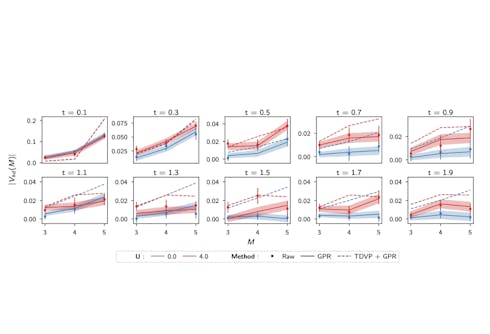
Simulation of the time-dynamics of fermionic many-body systems has long been predicted to be one of the key applications of quantum computers. Such simulations -- for which classical methods are often inaccurate -- are critical to advancing our knowledge and understanding of quantum chemistry and materials, underpinning a wide range of fields, from biochemistry to clean-energy technologies and chemical synthesis. However, the performance of all previous digital quantum simulations has been matched by classical methods, and it has thus far remained unclear whether near-term, intermediate-scale quantum hardware could offer any computational advantage in this area. Here, we implement an efficient quantum simulation algorithm on Quantinuum's System Model H2 trapped-ion quantum computer for the time dynamics of a 56-qubit system that is too complex for exact classical simulation. We focus on the periodic spinful 2D Fermi-Hubbard model and present evidence of spin-charge separation, where the elementary electron's charge and spin decouple. In the limited cases where ground truth is available through exact classical simulation, we find that it agrees with the results we obtain from the quantum device. Employing long-range Wilson operators to study deconfinement of the effective gauge field between spinons and the effective potential between charge carriers, we find behaviour that differs from predictions made by classical tensor network methods. Our results herald the use of quantum computing for simulating strongly correlated electronic systems beyond the capacity of classical computing.


