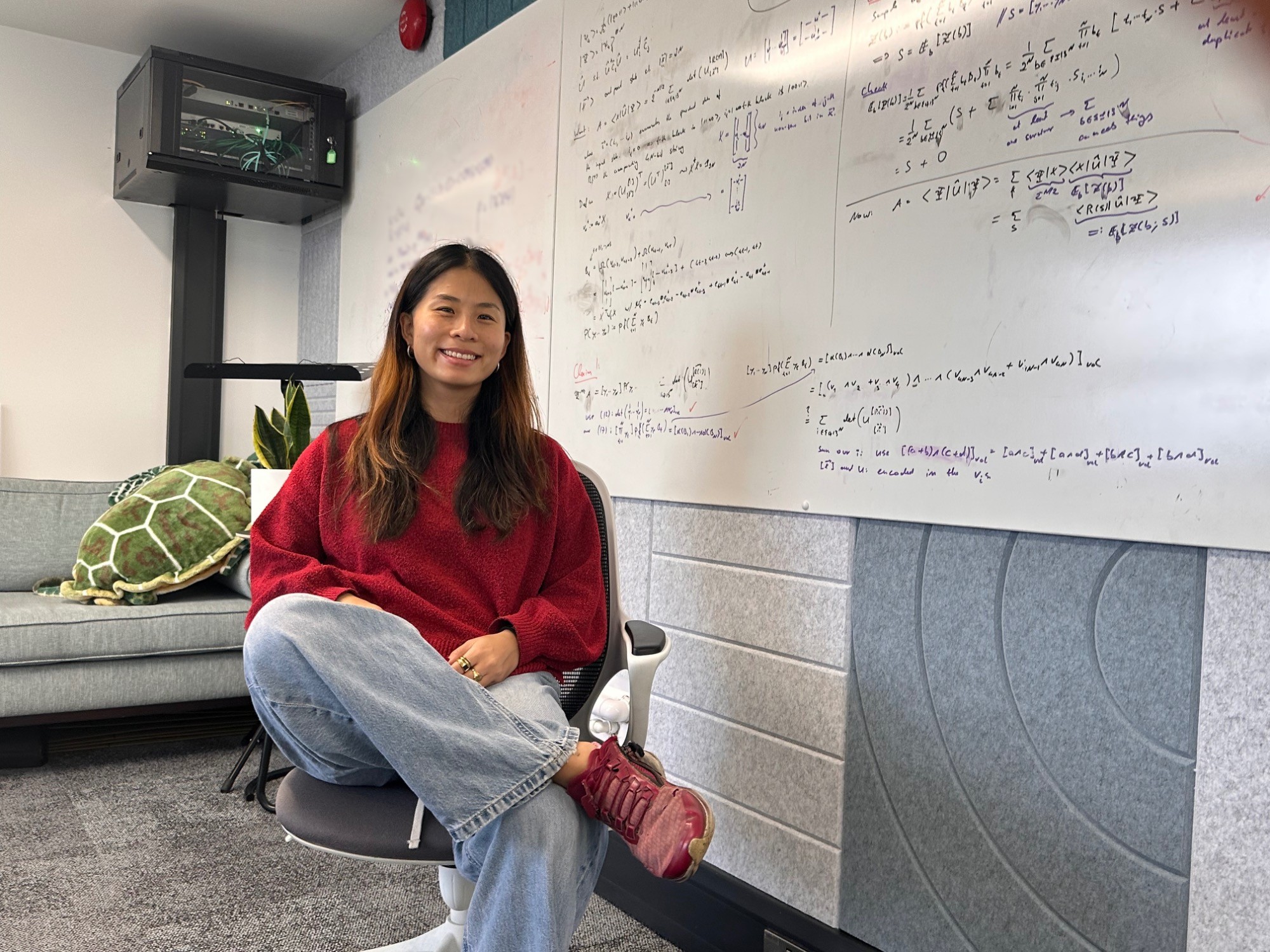
First up is Ieva Čepaitė, a Quantum Algorithm Scientist based in our London office.
Tell us a little about your role and what you do at Phasecraft?
Ieva: I’m a Quantum Algorithm Scientist, working on optimization. These are quantum algorithms for dealing with very hard, large-scale problems to make different aspects of life more efficient and effective, including scheduling, logistics and managing different networks.
What’s a problem you’ve worked on here that wouldn’t have been possible a few years ago?
A lot of the core algorithms have actually been around for a very long time. What’s changed in the last few years is being able to actually implement them on quantum hardware and see that the results make sense and are usable. A lot of recent work has gone into improving the analysis of these algorithms and improving our ability to implement them as efficiently as possible.
Projects like our optimization platform, Mondrian, are a really good example. A lot of the theory could have existed years ago, but we couldn’t verify it on a real quantum device. Now we have developed efficient pipelines for executing quantum optimisation algorithms in practice, answering questions about implementation that wouldn’t have even been asked in the past.
Why do you think it’s important to create algorithms that will bridge the gap between today’s quantum computers and future hardware?
I’m deeply passionate about the field. Part of that joy is the idea that it will actually be useful and can be genuinely implemented in the real world.
A lot of focus in quantum is on the distant period of extremely powerful machines with error correction and everything will just work. That’s exciting, but also very far away. What I really enjoy is thinking about the near term. You can actually run things on current devices, see what comes out and try to make it useful. This opens up many possibilities for innovation that can be missed if we only focus on the large-scale paradigm.
What’s harder than people expect about building quantum algorithms?
The very specific maths. You have to build a new intuition and throw away a lot of what you’ve learned in classical computer science because this is a completely new framework. I don’t know if this is harder than people expect, but it is one of the hardest things to wrap your head around!
What’s something people might not expect about working at Phasecraft?
We have space and breathing room to think deeply about problems and find solutions. This creates a really nice environment for research and I think that’s what allows people to do their best work.