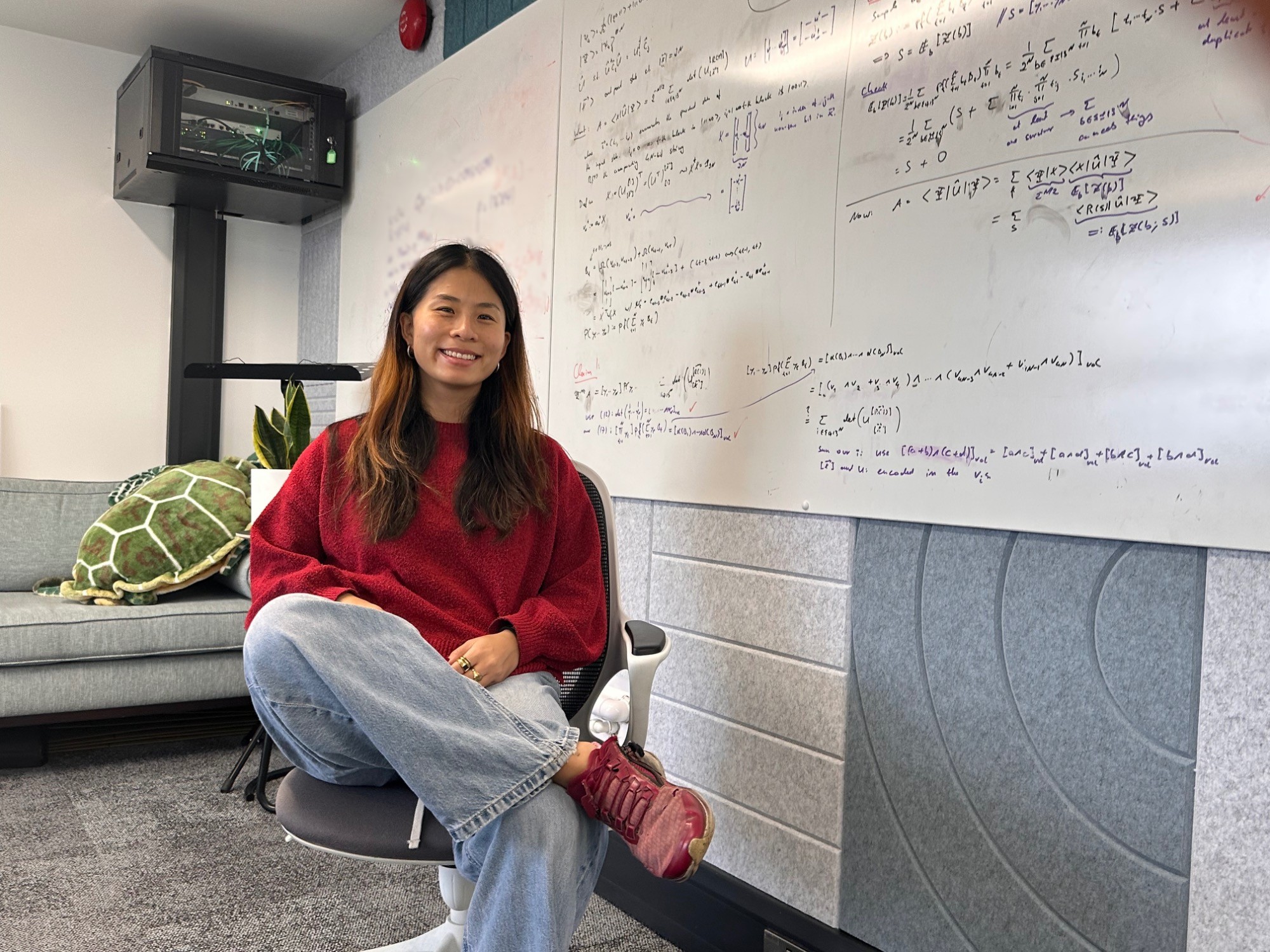
Inside the Lab with Sabrina Wang
Meet Sabrina Wang, a Senior Quantum Algorithms Scientist based at our Bristol office in the UK.
Tell us a little about your role and what you do at Phasecraft?
I am an algorithms researcher. That means I spend most of my time dissecting literature and either modifying existing algorithms or looking for new algorithms that can be tailored for specific hardware. I focus on the condensed matter and materials aspect of the near-term algorithms that we run at Phasecraft.
How long have you been with the company?
Nearly four years. I was doing a PhD at the University of Oxford in Computational Materials and had the opportunity to do an internship at Phasecraft in my final year. I really liked it here, so I decided to join full-time afterwards. (Hint: we are hiring.)
What's a problem you've worked on at Phasecraft that wouldn't have been possible a few years ago?
Just a few years ago, even the best hardware couldn't run even the simplest algorithms. It was a lot of effort. However, we’ve seen a huge effort from the hardware community to bring down noise, scale up, cut down runtime, plus increase capability and functionality. Because of this, it feels like our baseline of what’s achievable now is a lot higher, so the algorithms we design can be more ambitious. For example, on the material side, we can now simulate much bigger systems. It’s exciting! As well, the company is growing steadily, and we have a growing team of software engineers to help build the infrastructure required to complete big projects involving large throughput calculations.
Why do you think it's important to create algorithms that will bridge the gap between today's quantum computers and future hardware?
You don't really have to wait for fault tolerance to start running algorithms. There's going to be a transition between NISQ and fault-tolerant; there's going to be early fault tolerance, for example, where maybe not all of your qubits are logically encoded. If you have a few very good logical qubits, you can tailor algorithms to run on just those devices. It’s better to grow with the hardware capabilities, which is what we’re doing at Phasecraft. It won't be like a magical step ladder, though. It’s important that we, as a company, have tailored knowledge that grows with the state-of-the-art technology. This will ensure that we, as a company, can remain adaptive to new technology and better hardware when it arrives.
What's harder than people expect about building quantum algorithms?
Firstly, it's the sheer amount of insight and knowledge you have to have to see if something works, because there are a lot of different algorithms to do similar things, and understanding all of their pros and cons makes it difficult to know. We have to question ourselves: is this the best method? Can we improve it even more? You can always finish writing an algorithm, but it's definitely not optimal.
Secondly, I would say one of the hardest things is whether what we simulate actually translates to a real-world problem. From my perspective, on the materials and condensed matter side, our hope is that we can tailor algorithms for example, dynamic algorithms or hybrid algorithms for ground-state kind of chemistry, surface chemistry or catalysis, and material simulation methods.
Through your work simulating complex materials, what do you believe the future impact could be?
If we can emulate these materials more accurately, then it can have a lot of positive consequences. These lattice models we create can usually give birth to really interesting effects like superconductivity and topological order.
For example, it could supercharge R&D in pharmaceuticals through material simulations, and other sectors, such as battery manufacturing and engineering. Basically, if it requires materials, our work can be applied to it.
What's something people might not expect about working at Phasecraft?
How much autonomy you have with your research projects and to define your own goals. But I'd say the main thing is that it is really fun and I did not expect how easy it is to collaborate with colleagues. The founders have made sure that everyone has access to everyone, so the company is very flat. At Phasecraft, they've really focused on allowing researchers to do research, with a lot of free flow of information, and that makes it really easy to find the right person to help you or just bounce ideas off anyone who's interested.


